

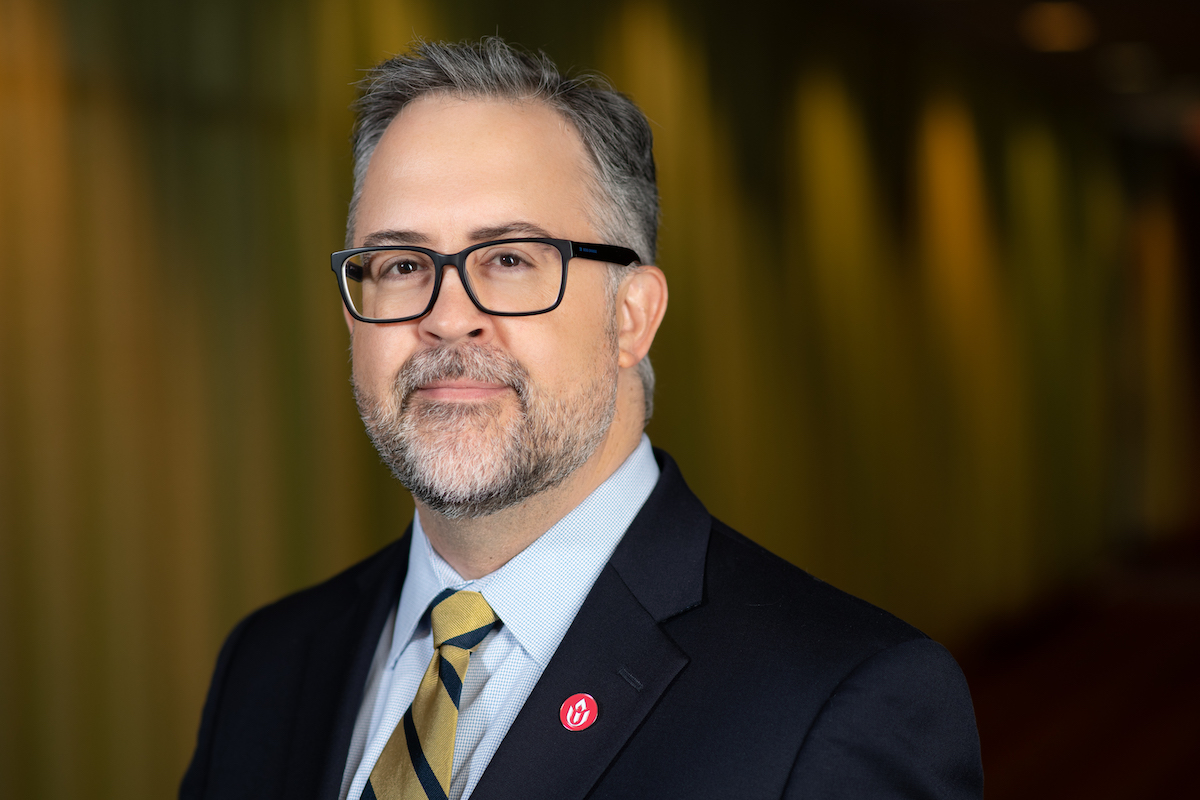
Rev. Scot Hull is a Minister in the Unitarian Universalist tradition. Born in Washington, DC, he was raised in the Maryland suburbs in a family of government bureaucrats. His first church experiences were at Cedar Lane Unitarian Universalist Church in Bethesda — as the story goes, this was the only church his northern Quaker grandfather and southern Methodist grandmother could agree on!
Rev. Scot attended the University of Maryland in College Park, where he was so taken with “Life’s Big Questions” that he decided to pursue a Ph.D. in Philosophy. Life (and debt) had other plans, and he went off to find his way in the blooming and booming world of information technology, Internet infrastructure, and the growing World Wide Web.
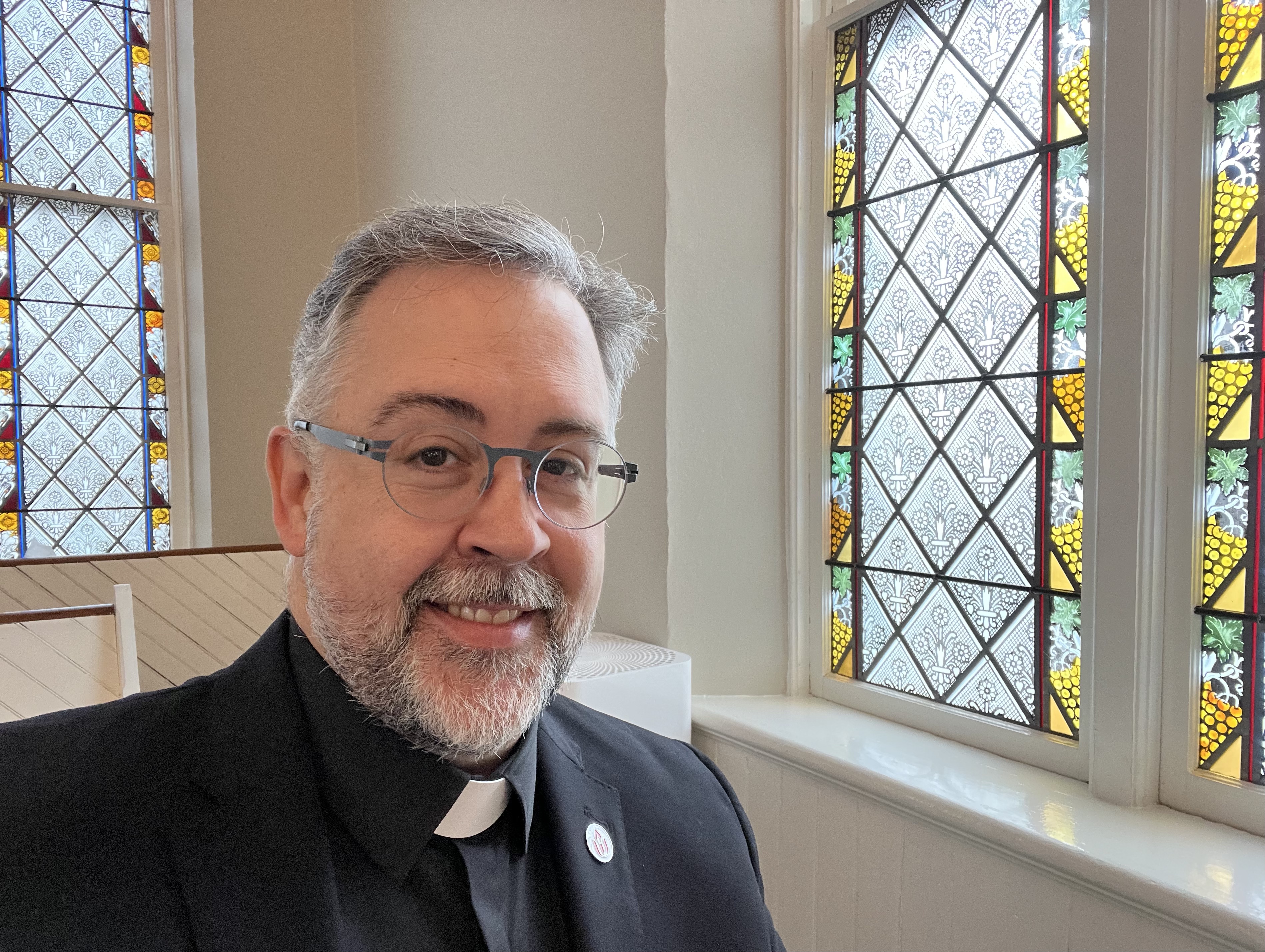
Over the next 25 years, Rev. Scot became a public speaker and technology evangelist in the field of Internet security, where he created and developed start-up businesses, led cross-functional organizations in large and small companies, wrote a book (and a lot of articles), taught seminars, and coached professionals and executives to lead and succeed in the world of technology sales.
After a long period of discernment, Rev. Scot left this career to attend Meadville-Lombard Theological School (a Unitarian Universalist seminary in the Chicago Theological School consortium) to pursue lifelong interests in comparative religion, theology, and Buddhist philosophy — a return to the “Big Questions”. It was on this path that he began to imagine a second career in professional pastoral ministry.
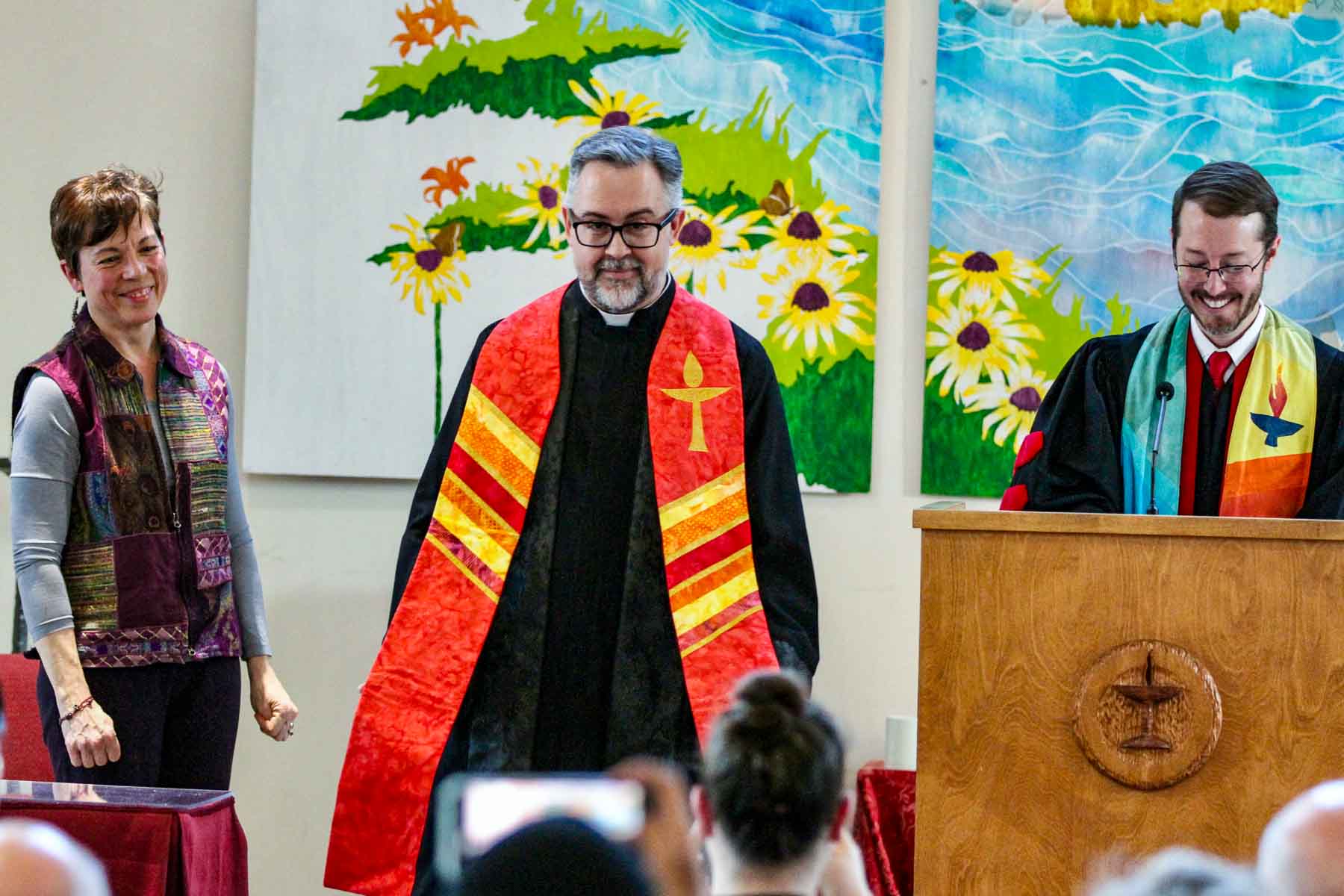
He was Ordained to the Ministry in February of 2020, mere weeks before the Great Shutdown of the COVID Pandemic. During that time of isolation, Rev. Scot received his first call — to the Unitarian Universalist Society of Geneva, IL, one of the oldest Unitarian churches west of Appalachia. He served there until 2025, when he and his wife, the Rev. Julia Jones, moved to Massachusetts to accept a rare opportunity to serve as co-ministers at an historic UU church on Cape Cod. Rev. Scot was welcomed into Full Fellowship with the Unitarian Universalist Association in 2023. He is currently pursuing his doctorate through the United Theological Seminary of the Twin Cities.
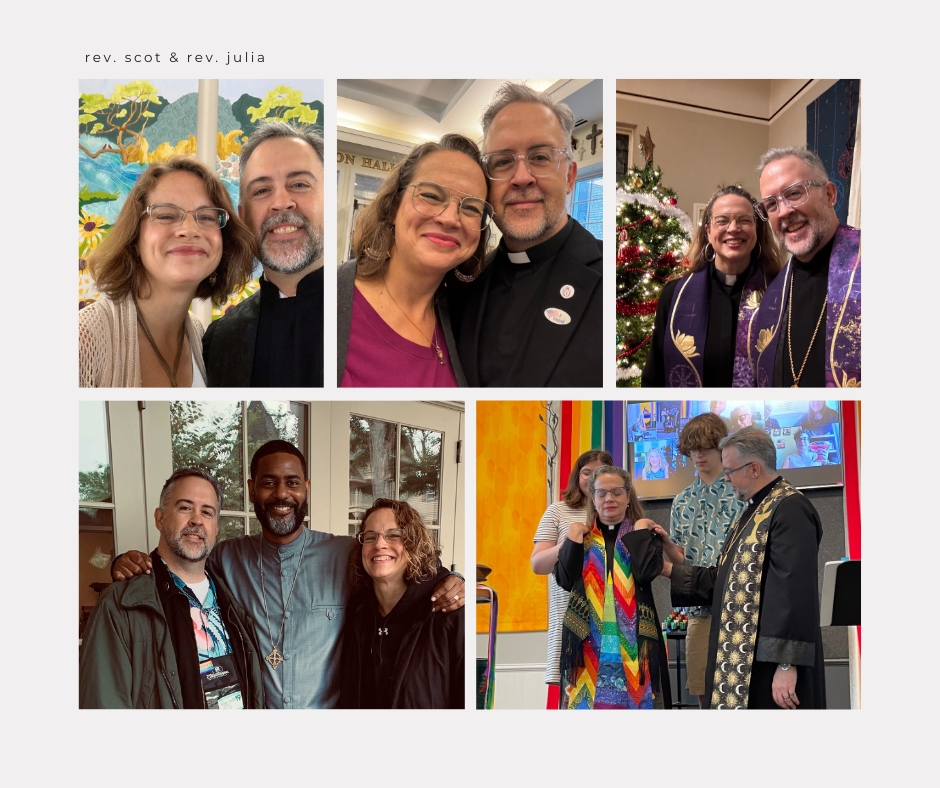
Rev. Scot and Rev. Julia have two college-aged kids (twins), two dogs (not twins), and extended family in Massachusetts, Maryland, Virginia, North Carolina, Wisconsin, and California.
Aside from collecting books (mostly science, philosophy, religion, and selections recommended by NPR and The NY Times), Rev. Scot actually likes to read science fiction and fantasy. One of his favorite pastimes is going to the movies and his famously bad taste in said movies (a judgment that he cheerfully disputes) is widely known.
When his kids were very young, Rev. Scot took night classes at L’Academie de Cuisine in order to become less boring, and there, he earned certificates in both French Cookery and Pastry. His family and friends were thrilled with the upgrade. As a way to “practice writing”, he (obviously!) started a cooking blog, but quickly learned that his was one of a million launched around that time (at the height of Food Network TV cooking shows). On a whim, he turned his keyboard to a hobby of some of his college friends: the practical mystery of hi-fi stereo systems. That clicked, and over the next decade, he turned a hobby into a profitable and vibrant media outlet that now reaches millions of readers a year, worldwide.
In a world pressured by global climate change, the rise of authoritarianism, and bedeviled by oppressions of race, class, sex/gender, Rev. Scot increasingly appreciates pragmatic and practical solutions that improve lives. With a growing conviction that our collective national future will only be possible with better communication across political, social, and economic boundaries, he looks to history, science, culture, and art for inspiration on how to engage, how to create meaning, and how to reimagine a better future.
As a third-generation UU, Rev. Scot chooses “not to hyphenate” (UU-Christian, UU-Pagan, UU-Humanist, or more); instead, he very much appreciates the full breadth available within the scope of Unitarian Universalist spiritual heritage, and his vision of church is “theologically inclusive” of, and informed by, those many sources. In particular, he has found regular inspiration in the insights of Religious Humanist, Buddhist and Jewish traditions. Given the current political climate, Christian theology, history, and sociology have become a necessary focus, specifically Christian deconstruction (and reconstruction) , especially for his political and community outreach work.
“Our church is part of a Living Tradition, one that draws wisdom from all the world’s religious traditions, balanced with the insights of modern science. We call ourselves ‘seekers after truth and practical goodness’ because none of us have all the answers. Instead, our ancestors taught us that community, character, and curiosity are stars by which we collectively might navigate a collaborative journey toward truth, justice, and meaning in our modern world.”
 The Holy Question Mark